Stuffed Cabbage Leaves – Cooking with Winter Vegetables

My husband got me a really interesting new cookbook for Christmas called In Season: Cooking with Vegetables and Fruits by Sarah Raven. I don’t usually spend a lot of time thinking about ways to cook using vegetables that are in season; a better description of my style would be haphazard or erratic (and let’s face it, I don’t really spend a lot of time thinking about vegetables, period). But this is a beautiful book with a lot of great ideas.
onions

For January and February cooking, the book recommends cabbages, chicories, citrus, evergreen herbs and winter salad greens. I decided to try a stuffed cabbage recipe.
rice onions turkey bacon and pork

Back in November, Edwin posted a quasi-Indian style vegetarian cabbage roll dish. This one is pretty different from that (the original recipe author is from Hungary). The recipe in the book called for a lot of things – bacon, ground beef, chopped mixed herbs and sauerkraut. It was my goal to pare it down a bit. I also tried to make it a little healthier, eliminating the bacon for turkey bacon and holding off on the ground beef completely.

cabbage rolls

This was my first dish from this book, and I was a little disappointed at the way the instructions are written. A few of the steps seem to leave a great deal to the imagination. For example, Edwin’s cabbage recipe calls for boiling the cabbage head until the leaves begin separating. My recipe didn’t mention anything about that, and so I found it very difficult to peel off the leaves in one piece. I probably pulled off about 6 large, fat leaves and the rest were moderately ripped and shredded in the process. Hopefully it was just a fluke for this recipe.

I think this turned out well and I will likely make it again. What do you put in your cabbage rolls?
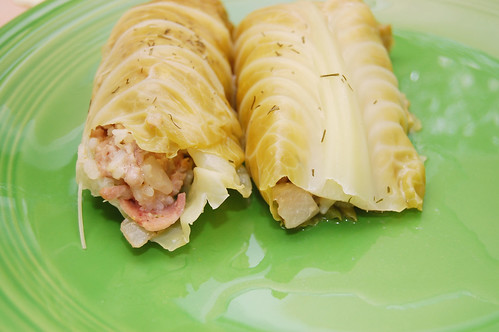
cabbage rolls ready

Stuffed Cabbage Leaves
adapted from In Season: Cooking with Vegetables and Fruits
(yields about 20 rolls, total prep and cook time is approx. 1 1/2 hours)

1 cabbage
2 bay leaves
3/4 cup (6 ounces) turkey bacon, chopped
1 onion, chopped
3 garlic cloves, minced
1 teaspoon paprika
1/4 teaspoon ground cumin
1/2 teaspoon marjoram, thyme and dill
salt and pepper (dash)
1 pound ground pork
1/2 cup cooked long-grain white rice
1 egg, beaten
1 cups chicken broth

Preheat oven to 350F.

(I’ve inserted Edwin’s instructions here for peeling the leaves so that you don’t have the same problem I did) – Core the hard part of the cabbage (the stem mostly) from the base. Boil in a large pot of boiling, salted water. In about 5-10 minutes, when the leaves begin separating, remove from the pot. Let cool.

Remove the thickest part of the cabbage leaves to make them easier to roll.

Fry the turkey bacon in a shallow pan and set aside. In the same pan, add onion, garlic, marjoram, thyme, dill, paprika, cumin, salt and pepper on low heat so as not to burn it.

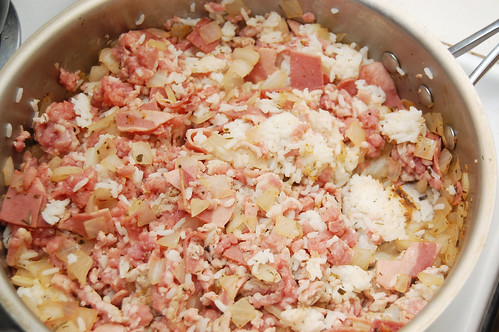
In a large skillet, combine raw pork, cooked rice, cooked turkey bacon and onion mixture. Add the beaten egg to bind the mixture and season with salt and pepper. Stir occassionally until cooked.

When cooked, place approximately two spoonfuls of the mixture on a cabbage leaf. Roll the leaf, starting from the stem and and tuck in the edges. Place the rolls, seam down, in a shallow baking or casserole dish. Pour brother over the leaves and add bay leaf and a dash of dill. Cook, covered, for approximately one hour.
Khitcheri – Time For Some Detox

The problem with baking (well, ok, ONE of the problems) is leftovers; because when you have leftovers, you inevitably end up consuming them when you really should be consuming something else. Oatmeal for breakfast? Nah…

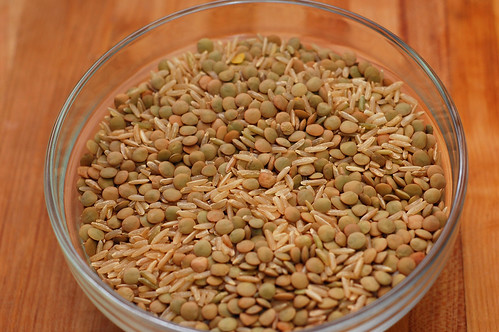
Lentils and Basmati Rice

That was the story of my Sunday after baking a coconut cake for a friend’s birthday on Saturday. It leftovers were just a little too awesome to resist so in an attempt to balance the scales (and just placate my own mental anguish) I decided on something much simpler and lighter for dinner.

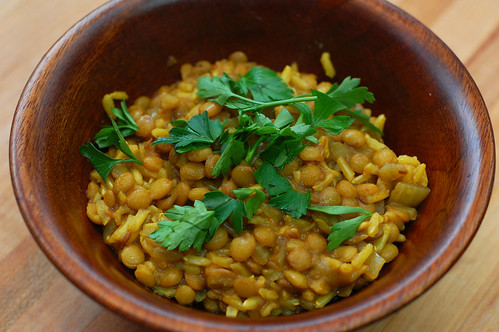
Kitcheri is a simple dish, Indian in origin. It’s been attributed to having a cleansing effect on the body; something I felt I could use. Don’t expect to be bowled away by this dish. It’s flavor is mild and subtle. Enjoy it when you’re in the right mood.

Kitcheri

Kitcheri
1 cup green lentils; rinsed
3/4 cup brown basmati rice
3 tablespoons oil
1 teaspoons cumin seeds
1 onion; chopped
2 garlic cloves; minced
1/2 teaspoon ginger; minced
2 teaspoons coriander
4 cups stock (or water)
1/2 teaspoon turmeric
salt to taste
parsley as garnish (optional)

Soak the lentils and rice for 30 minutes.

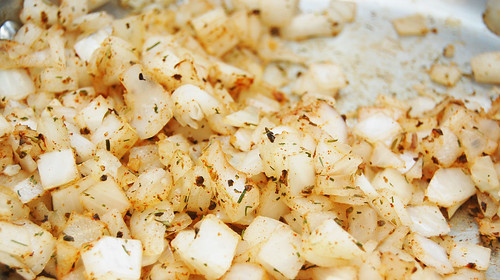
Under medium heat, roast the cumin seeds with one tablespoons of oil for 20 seconds. Add the additional oil along with the onion, garlic, ginger and coriander. Sweat for 2-3 minutes. You should smell the ginger and the onions should begin to look translucent.

Add the water, turmeric, lentils and rice. Simmer for 20-25 minutes or until the rice is soft; adding salt to taste. Let sit for 5 minutes and serve with parsley as a garnish. Enjoy

If you’ve spent some time trying to cook meals from scratch then you’ve probably across the terms sautéing and sweating. These are pretty common terms for many recipes where you simply apply combine heat, vegetables (often aromatics) and a little fat (often oil). However this deceivingly simple trifecta hides many processes that can yield wildly different results. Today we’ll focus on the two most common.

Sauté comes from the French word sauter, to jump, and it’s where you apply relatively high heat to brown the ingredients, trapping in its moisture and flavor. The goal is to preserve the uniqueness of the individual ingredient with only minimal, subtle mingling of flavors. This is often used in dishes like stir-fries or perhaps as an initial step before searing some meat. I personally love sautéd onions and peppers in my burgers (when I eat burgers, of course). The browning tends to add its own unique touch to the ingredient; enhancing it.

Sweating comes from the Italian word soffrito, underfrying, and this is done with low heat. The goal of sweating is to pull the flavor out of the vegetables so that it can influence the liquid in your dish along with the other ingredients. You will often find this done in one of my most often cooking forays: soups. Certain vegetables, like onions, will become translucent after sweating and very little browning should occur. If you see browning, it’s often a sign that your heat is too high or amount of fat is too low.

I find that some people don’t pay full attention to which one they’re doing when cooking. I strongly encourage you to take a moment next time your working with something like a mirepoix to ask yourself what the recipe is telling you to do and why it makes sense (or doesn’t) with the dish you’re making. Enjoy.

Hearty and Sweet Agave Trail Mix Cookies

Ever since 101 Cookbooks posted that Black Bean Brownie recipe I have been interested in agave syrup (you know, the one I attempted and failed because of accidentally doubling the black beans, but then created something kind of marvelous in its place?). Cookie Madness also picked up on the agave craze and has been investigating.

granola

Agave is a type of plant, typically found in Mexico, that has thick, pointy leaves. It actually looks a little like aloe. There are a lot of things you can do with it (like make tequila… no thanks!), but you can also use the syrup/nectar from it as an alternative to sugar. Vegans may like it as a substitute to honey, and diabetics can appreciate its low glycemic index.

trail mix

It’s a powerful little plant, so it’s not a one-to-one ratio of subbing in agave syrup for sugar. One cup of granulated sugar can generally be replaced with 1/3 cup of agave syrup.

oats

So I was chowing down on a small bowl of my new favorite cereal – Nature’s Path Organic Pumpkin Flax Plus Granola with Omega-3 – with all this in mind while I was thinking up a new wholesome cookie recipe (I know the granola sounds really questionable and much like Chef Edwin’s personal hell… but I promise you, it tastes great!). I wanted a cookie that would be hearty and full of oats but without tasting bland, tough and like bran (we’ve all had THOSE before). Mid-bite I remembered a small bag of trail mix that someone gave me as a gift that had been sitting in the pantry. Yum, a trail mix cookie was born!

agave

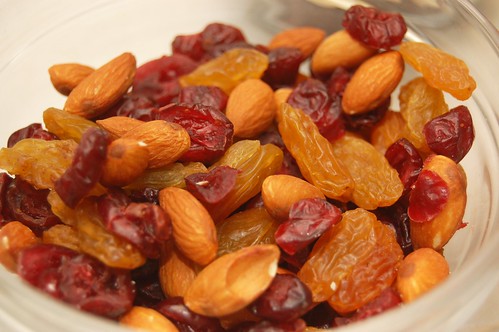
The key players were Nature’s path granola, trail mix that included dried cranberries, almonds and golden raisins, oats, a little bit of coconut and a small combination of semi-sweet, white and peanut butter chips. Everything came together beautifully.

trail mix cookies

I was a little nervous at first because the agave syrup and butter didn’t seem to want to combine, but once I began adding other ingredients it was fine. Because I used agave, I didn’t get the crispy, browned edges and bottom that typically come from using sugar, so it might feel a little different. But the taste was great. My husband kept going back to the jar (very unusual for him!) and exclaimed that he loved finding a bite with a dried cranberry. I also gave him some to take to work and apparently they went over extremely well. This cookie has a lot of tasty nooks and crannies to explore!

Trail Mix Cookies

Agave Trail Mix Cookies

3/4 cup Nature’s Path Organic Pumpkin Flax Plus Granola with Omega-3
3/4 cup trail mix (a mix of dried cranberries, almonds and golden raisins)
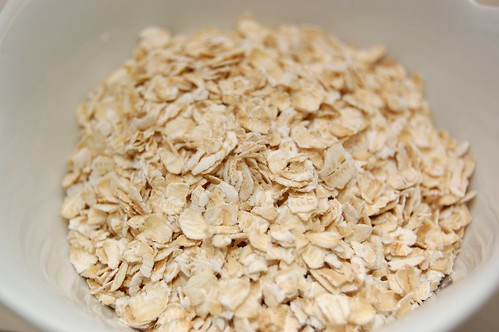
1/2 cup oats (regular, not instant)
1/4 cup white chocolate chips
1/4 cup semi-sweet chocolate chips
1/4 cup peanut butter chips
1/4 cup shredded coconut
7 ounces (slightly more than 3/4 cup) all-purpose flour
1/2 teaspoon baking soda
1/2 teaspoon baking powder
3/8 teaspoon salt
1/3 cup agave syrup
1 stick unsalted butter, room temperature
1 large egg
1/2 teaspoon vanilla

Preheat oven to 350 F. In a large bowl, combine granola, trail mix, oats, semi-sweet, white and peanut butter chips, and coconut. Set aside.

In a medium bowl, sift flour, baking soda, baking powder and salt. Whisk to combine.

Beat room temperature butter until smooth. Add agave syrup, vanilla and egg. Beat well. Fold in flour, baking soda, baking powder and salt. Then fold in granola, oats, trail mix, chips and coconut.

Use a tablespoon to scoop large balls of dough onto a parchment lined baking sheet. Place balls approximately 2 inches apart. Bake approximately 12-15 minutes. Cool on baking sheet for 3 minutes, then transfer to wire rack to cool completely (these cookies cooled surprisingly fast). Store in an air-tight container.

Makes about 2 dozen cookies.

Christine Ilich's Apple Autumn Borscht

One of the great things about volunteering at L’Academie (besides the great recipes and hands-on learning) is meeting the chefs. It’s great to be exposed to the different kinds of styles, to hear their story on how they became who they are today and to just pick their brains. Every chef reached their dream in a different way and a few of them realized their dream wasn’t what they first thought it was.

Whole Lotta Beets

Christine Ilich is a formally trained chef that I’ve mentioned briefly before after volunteering for one of her classes. She runs her own business, Heirloom Kitchen, in Front Royal making homemade soups, breads and sweets. I can tell you that her bread baking classes are immensely popular, but it was her soups that hooked me. We made three; a bisque, minestrone and a chowder. All very different, all amazing and all flexible with the recipe (cooking is an art!). I was a fan. During the class we somehow got on the discussion of other soup and she mentioned today’s recipe: Apple Autumn Borscht.

Preparing Apple Autumn Borscht

I had never worked with beets before, never mind made a borscht, so this was a great experience to broaden my horizons. While the ingredient list for this dish isn’t particularly long, its flavor is deceivingly complex. I dare say most would not be able to identify the ingredients from taste. I strongly recommend you try this recipe and if you have any questions for Christine, send her an e-mail.

Apple Autumn Borscht

Apple Autumn Borscht
Chop the vegetables into large pieces since everything will be pureed in the end.

3 tablespoons butter
3 carrots, peeled and chopped
3 apples, peeled and chopped
1 onion, chopped
1 3-inch piece of fresh ginger, peeled and sliced
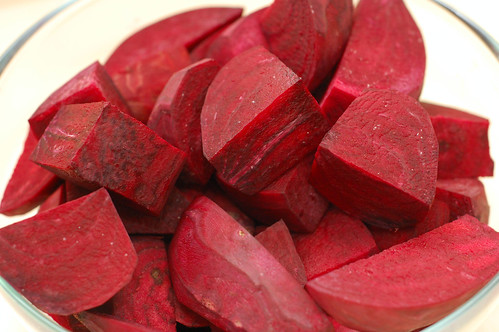
6 medium sized beets, peeled and chopped
2 large or 3 medium sized sweet potatoes, peeled and chopped
1 tsp cinnamon
1/2 tsp nutmeg
juice of 1 lemon
1-2 cups heavy cream
Salt & pepper
Sour cream

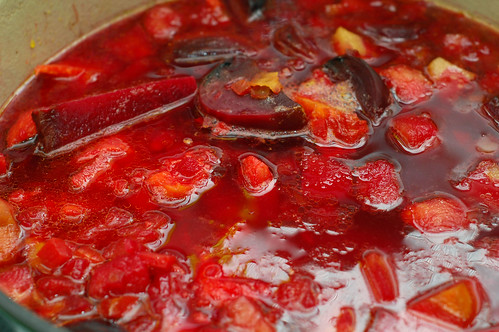
Place butter, carrots, apples, onion and ginger in heavy bottomed soup pot. Sauté until vegetables are softened, but not browned (a little color is ok). Add beets and cover with water. Bring to a boil, season with salt and pepper and reduce to simmer. Cook for about 10 minutes, or until beets are starting to soften. Add sweet potatoes (and more water if needed, to just cover the potatoes) and cook until all veggies are very soft. Add spices and lemon juice. Puree the mixture in blender with the cream. Taste and re-season if necessary, with spices, lemon juice, salt and pepper. Serve hot with a dollop of sour cream.

Food Photography – Georgetown Cupcake

Georgetown Cupcake

(Pictured: A half-dozen mouth-watering cupcakes from Georgetown Cupcake in Washington, DC. From top left to bottom right – toasted marshmallow, mocha, red velvet, vanilla with vanilla frosting, chocolate with chocolate ganache and chocolate with coconut frosting.)

And yes, my husband and I did eat all of them in one night.

Thai Red Curry Soup with Vegetables

Have you ever set out to prepare something only to find out you’re missing a crucial ingredient? I hate when that happens, and happen it did this Sunday morning. I was all set to make a delicious German oven pancake when I realized I was out of milk. It doesn’t get much more crucial than milk and embarking on a grocery store adventure was not conducive to my lazy Sunday plans. A substitution of coconut milk came to my rescue which unfortunately left me with quite a bit leftover to tend with.

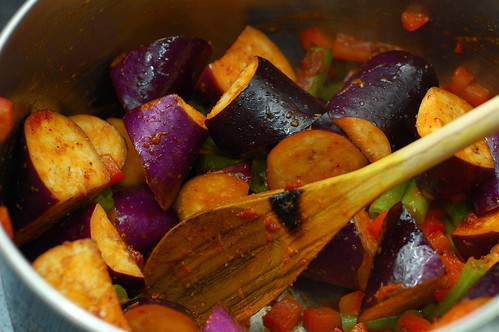
Eggplants with Curry

I hate to waste food. It’s just so…. wasteful (I look forward to my excellence in writing award later this year). Enter today’s recipe. As you probably already know I’m quite fond of soups and on top of that, this recipe uses a few vegetables that don’t fall under my “staple” category. The original recipe was a chicken dish so I vegetarian-ified it, throwing in some lentils for protein. I’m not much of a thai cook, but I was satisfied with the results.

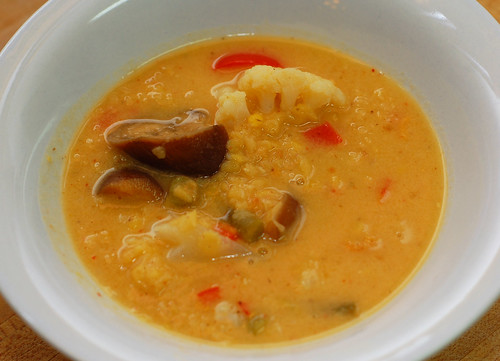
Thai Curry Soup

Thai Curry Soup with Vegetables
adapted from Epicurious

2 tablespoons oil
1 1/2 tablespoons red curry paste
1 red bell pepper; diced
2 chinese eggplant; chopped
4 oz green beans; chopped into 1 inch pieces
8 ounces cauliflower; cut into small pieces
2 cups red lentils; rinsed
3 cups coconut milk
4 cups stock
1 tablespoon fish sauce

Steam the cauliflower for 8 minutes and immediately dunk in cold water to stop the cooking.

In a large pot, cook the oil, curry paste and red bell pepper under medium heat for two minutes. Add the eggplant and green beans and cook for another 2 minutes, stirring to ensure everything is coated with curry. Add the milk, stock, fish sauce, cauliflower and lentils, bringing everything to a boil. Let simmer for 15 minutes. Add salt to taste. Enjoy.

Creamy Orecchiette Pasta with Broccoli and Vermont Cheddar

If you caught the cover of the February/March 2009 Food Network Magazine, then you saw a gorgeous Orecchiette Pasta with Broccoli Rabe Pesto. I couldn’t wait to make it.

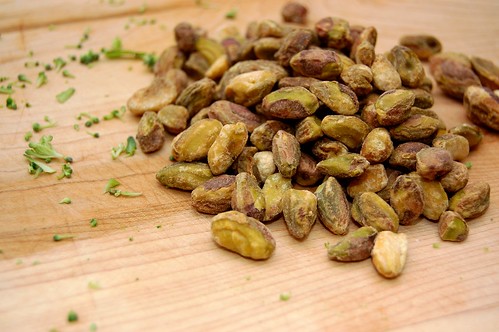
pistachios

Except I didn’t know much about broccoli rabe – which turns out to be nothing at all like broccoli. So I decided to go with what I know and see if this recipe works with regular broccoli. I also replaced the parmigiano-reggiano cheese with a sharper, more pungent cheese to give it a bit of zip.

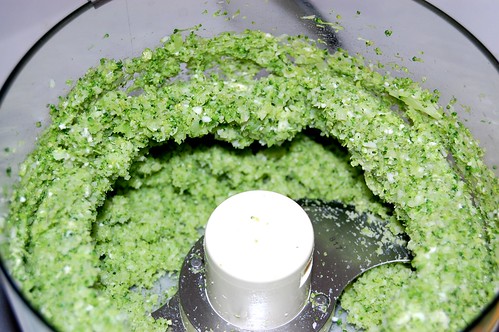
broccoli mixture

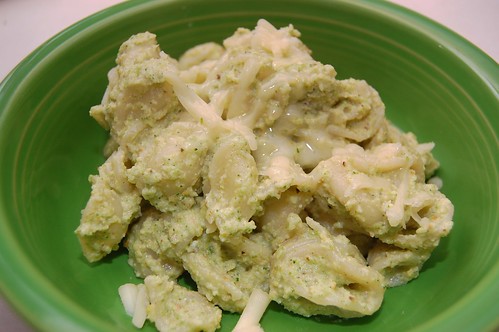
Without the bright green contrasting colors this dish may not look as lovely the Food Network Magazine cover, but I really enjoyed it. The orecchiette pasta is a lot like shells, hiding little salty pistashio nuggets in every other bite. It’s like a grown-up macaroni and cheese, with broccoli and pistachio being the more dominant tastes than the cheese.

If you’re in the mood for something a little different, this is for you!

orecchiette pasta

Orecchiette with Broccoli and Vermont Cheddar
Adapted from Food Network

2 1/2 cups broccoli, chopped
1/2 cup pistachios, toasted
1 cup Vermont Cheddar, shredded
1/2 cup part-skim ricotta cheese
1/2 pound orecchiette pasta

Cook pasta according to package instructions. Meanwhile, puree broccoli in bowl of a food processor. Add toasted pistachios, followed by Vermont Cheddar. Finally add ricotta and pulse until smooth. Add salt and pepper to taste.

Add broccoli mixture to a large skillet and add 1 cup of the pasta water. When pasta is cooked, drain and add to the skillet with the broccoli mixture. Stir vigorously to combine and cook until the sauce is creamy and hot. Add more salt and pepper to taste. Garnish with shredded Vermont Cheddar.

Kitchen Tips – Creaming Butter and Sugar

You know you’re obsessed with baking when you describe to a friend that watching the stages of creaming butter and sugar is a “euphoric experience.” Luckily that friend was none other than my co-blogger Chef Edwin, so he did not report me to the authorities and the men in white coats never came to get.

From very early in my baking career I began seeing the phrases “cream butter,” “cream butter and sugars,” or “cream until light and fluffy.” Of course, I had no idea what this meant, and I heard a variety of explanations when I asked others.

creaming2

The best and clearest step by step explanation that I’ve found was in my frequently raved about favorite cake book CakeLove: How to Bake Cakes from Scratch by Warren Brown (thank you again for the wonderful gift, Lisa!). Warren Brown is also a bit of a personal hero to me because he went to law school, became a lawyer, realized he didn’t enjoy it and left to open a bakery! He writes:

“For a while before I started baking, I didn’t recognize the disconnect between my daily conscious self and the voice of discontent in my head. I acted happy but I was really torn. I don’t know when this started but the conflict seemed normal. I just figured I’d deal with it like everyone else who was moping about in their late twenties: bury it, ignore it, or wait for something to change. But settling started to take a toll. I felt like a bobbing mooring, not going under but also not going anywhere. Even though I knew that I wanted out of practicing law, I didn’t know what I should do instead or how to get there. To figure it out I tried looking at my future retrospectively, picturing myself twenty years in the future. I envisioned two possible paths: work hard for twenty years and develop an expertise in law, then pursue the dreams that were already building in my head; or skip the middle-aged agony and get on with my pent-up passions right away. I chose the latter because my gut said, “Who are you kidding – avoid the midlife crisis you can predict! Start baking!”

If that’s not a battle cry, I don’t know what is. I withdrew from law school in 2006 after realizing very early on that law school and I were incompatible in every way. It was one of the best decisions I’ve made. I have not opened a bakery (yet?), but clearly I have great respect and admiration for Warren Brown (Mr. Brown, if you need a new spokesperson, please contact me).

But back to creaming – creaming aerates your cake batter and adds bubbles to it, making it light and fluffy instead of dense or tough. It also allows your cake to rise and develop a great texture.

poundcake

The absolute best way to do it is to combine room temperature (not microwaved) butter with your sugar(s) in a stand mixer on the lowest speed using the paddle attachment (not whisk). If you don’t have a stand mixer but you see a good deal of baking in your future, then consider giving the economy a little boost and investing in one. I use it constantly.

Do not rush the creaming process. As the sugar pushes through the butter you’ll see the volume slightly increase as the mixture becomes fluffy, light yellow and a little grainy. Creaming should take at least 3 minutes; do not turn up the speed on the mixer any higher than low. If you don’t have a stand mixer, do your best with electric beaters. You really can’t get the same effect trying to do this by hand. Also, creaming is not a concern for brownies or cookies.

When done properly, as I said above, watching the butter and sugar push and pull and become fluffy is so satisfying! You will make some truly mouth-watering cakes. And if at first you don’t succeed – keep plugging away!

Curry Couscous with Chickpeas

So I recently came to the conclusion that I’m not getting enough whole grains in my diet. This, to be quite honest, is an understatement. I don’t normally partake in the breads and pastas of the world. Not because I don’t like them (LOVE bread), but simply because I like to snack, and snacking on fruit just strikes me as a healthier course of action.

One Cup Couscous

Enter couscous. You may remember that Heather recently wrote about spicy shrimp and couscous, talking briefly about healthy eating. Couscous definitely fits the bill. This stuff will fill you up without weighing you (or your scale) down. When you cook this stuff it balloons in size. A quarter cup uncooked yields three quarters of a cup cooked! And less than 200 calories! I think I found a new best friend.

Stir-Frying It Up

This recipe comes from a cook book I’ve recently begun playing with: A Taste of Heaven and Earth. So far I’ve enjoyed cooking from it. It strives for simple dishes with sophisticated flavor and its ingredients are relatively common; obtainable at your average grocery store. Can’t find fault in that.
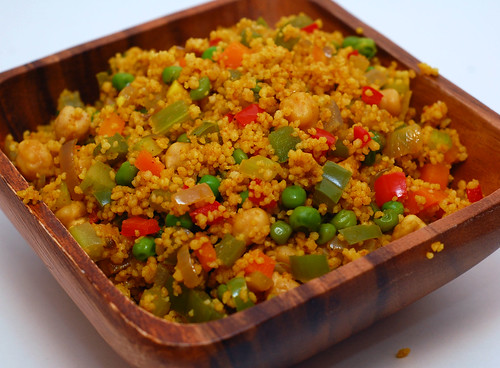
Curry Couscous with Chickpeas

As usual, I’ve upped the vegetable count significantly. Having tried this, I strongly recommend adding cauliflower; which I’ll be sure to do next time. And of course the usual spice disclaimer applies. I used four tablespoons of hot curry and it was a bit much.

Curry Cousous with Chick-Peas
adapted from A Taste of Heaven and Earth

1 cup whole wheat couscous
1 cup stock (or water if you must)
2 tablespoons oil
1 red onion; chopped
1 carrot; peeled and diced
1 celery stalk; diced
1 green bell pepper; diced
1 red bell pepper; diced
3 garlic cloves; minced
3-4 teaspoons curry powder; depending on your heat sensitivity and type of curry
1 cup cooked chickpeas
1 1/2 cups peas; fresh or thawed and drained
ground pepper to taste
tamari to taste (soy sauce in a pinch)

Bring the stock to a boil in a small sauce pan, add the couscous, cover with a tight fitting lid, remove from the heat and let sit for five minutes.

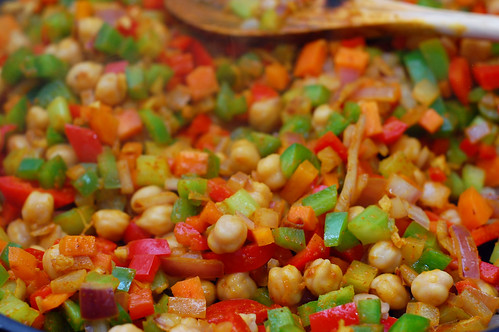
With the oil, saute the onion, carrot and celery in a large pan (or wok) under medium-high heat until the onion is translucent; approximately 3-4 minutes. Add the bell peppers, garlic, chickpeas and curry, sauteing for an additional 2-3 minutes. Be sure to stir constantly so the curry mixes and to prevent the garlic from burning.

Reduce the heat to medium-low, add the chickpeas, peas and couscous and stir together for a two to three minutes. Remove from heat and serve with tamari and ground pepper. Enjoy.